Transaction Center
Time to bring it home. Find zipForm®, transaction tools, and all the closing resources you'll need. Except for the champagne — that's on you.
View the latest sales and price numbers. Find out where sales will be in upcoming months.
Get a roundup of weekly economic and market news that matters to real estate and your business.
Gain insights through interactive dashboards and downloadable infographic reports.
All Shareable Reports All Interactive DashboardsCatch up with the latest outreaches and webinars by the Research and Economics team.
C.A.R. conducts survey research with members and consumers on a regular basis to get a better understanding of the housing market and the real estate industry.
California Model MLS Rules, Issues Briefing Papers, and other articles and materials related to MLS policy.
Looking for information on how to file an interboard arbitration complaint? You've come to the right place! Find the rules, timeline and filing documents here.
Summaries and photos of California REALTORS® who violated the Code of Ethics and were disciplined with a fine, letter of reprimand, suspension, or expulsion.
The most recent edition of the Code of Ethics and Standards of Practice of the National Association of REALTORS® along with other important links to NAR information.
The California Professional Standards Reference Manual, Local Association Forms, NAR materials and other materials related to Code of Ethics enforcement and arbitration.
Resources for Hearings via Zoom Online Training for Professional Standards Volunteers Professional Standards Webinars Professional Standards Film Festival Statewide Professional Standards Program Professional Standards Administrator Certification Arbitration and Mediation Forms Table of Contents Professional Standards Train-the-TrainerC.A.R. advocates for REALTOR® issues in Washington D.C., Sacramento and in city and county governments throughout California.
CREPAC, LCRC, IMPAC, ALF and the RAF comprise C.A.R.'s political fundraising arm.
The RAA: Protecting REALTORS® and Homeownership REALTOR® Action FundC.A.R. Senior Vice President Sanjay Wagle sits down with Republican Assemblymembers Heather Hadwick and David Tangipa for a “Meet the Freshmen” conversation about their first term in the Legislature, what they’ve learned, and how they hope to move forward in 2026.
Learn how you can make a difference, by getting involved yourself or by passing along valuable information to your clients.


|
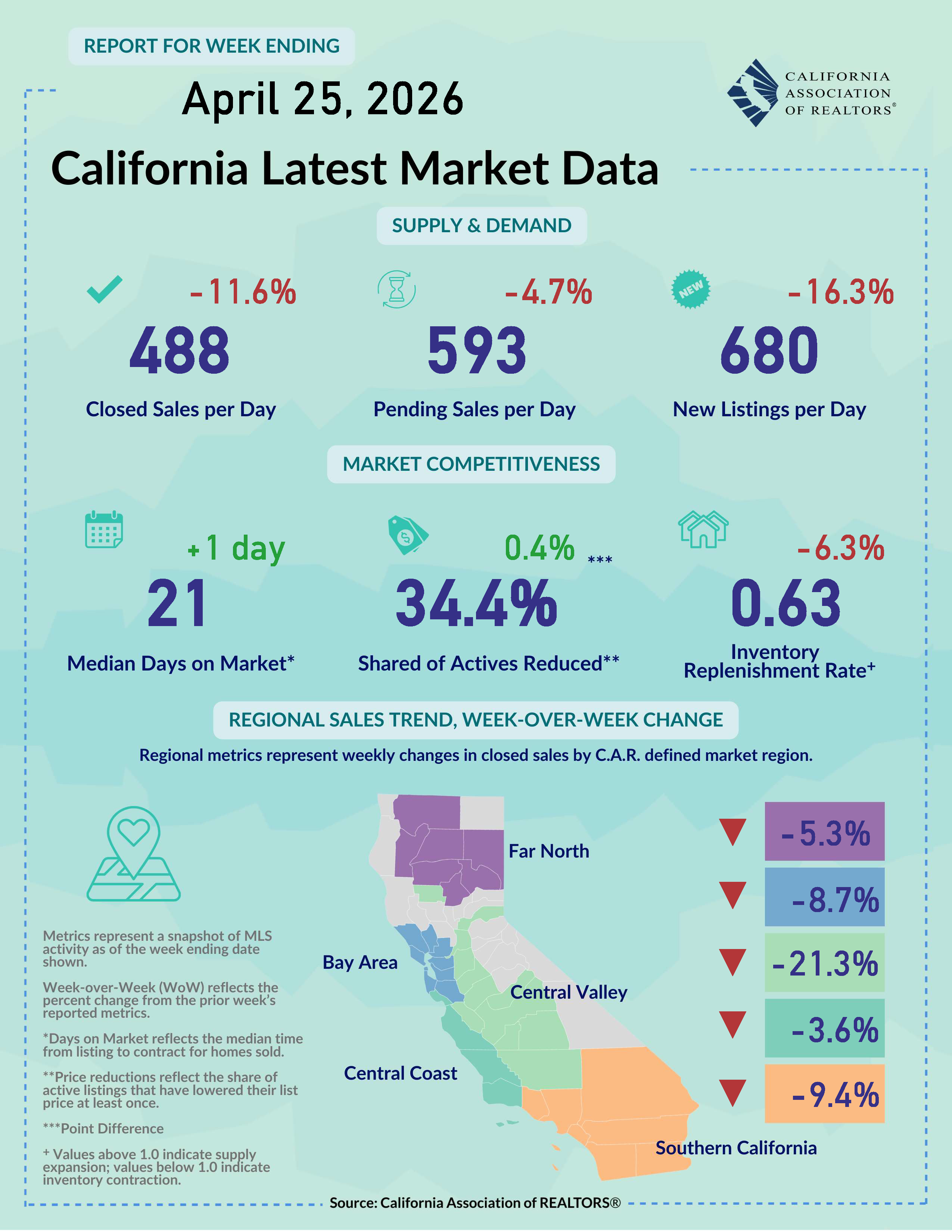
April 27, 2026 – The economy continues to show signs of stabilization—an encouraging development for the housing market. However, the outlook remains clouded, with uncertainty elevated as the Iran conflict remains unresolved and continues to pose downside risks to growth, jobs, and consumer confidence. Against this backdrop, affordability has improved modestly, policy efforts are gaining traction, and market participation is shifting across generations. With mortgage rates down from the late-March peak, more buyers may move off the sidelines if geopolitical tensions do not intensify. Housing affordability improved for all in 2025, but gaps remained wide: Housing affordability bounced back across the board in 2025, and changes were virtually the same between ethnic groups. The share of White (non-Hispanic) households that can afford to buy a median-priced home in California climbed from 22% in 2024 to 23% in 2025, and housing affordability for each major ethnic groups included in the annual C.A.R. report all increased one percentage point (ppt) from their year-ago levels. Housing Affordability Index (HAI) for Asians increased to 29% in 2025 at the state level, while Hispanic/Latino households and Black households both improved to 11%. Housing affordability gaps remained wide in 2025 though, as home prices inched up while mortgage rates moderated slightly but stayed elevated. The difference in affordability between Black households and the overall population in California widened from 8.3 ppts in 2024 to 8.7 ppts in 2025, while the gap for Hispanic/Latino households dipped from 8.2 ppts in 2024 to 7.9 ppts. While interest rates are projected to slip in 2026, the gap in affordability between ethnic groups will likely remain wide this year as home prices are expected to edge up in the next 12 months. Middle-Class Homeownership Act qualifies for the ballot: A proposed California ballot measure to create a $25 billion, self-financed loan program to help middle-income households buy newly built homes has officially qualified for the state’s November ballot. Instead of using taxpayer funding, the Middle-Class Homeownership Act would be financed through state-issued revenue bonds and not general obligation bonds. Eligible buyers— those who earn up to 200% of area median income, would provide at least 3% down, while the program could finance up to 17% of the purchase price through a fixed-rate, subordinate loan that functions like down-payment assistance. Homes must be newly constructed, owner-occupied, and subject to county-specific price caps. Borrowers would make monthly payments on the subordinate loan and must repay any remaining balance when they sell or refinance. The program could spur construction of roughly 190,000 new homes and expand supply while improving affordability for the “missing middle.” Jobless claims tick up but remain stable: U.S. initial jobless claims rose 6k to a seasonally adjusted 214k for the week ended April 18th, but layoffs remained stable amid the Iran war that continues to pose downside risks. Despite the lingering economic uncertainty due to the conflict in the Middle East, there are no signs yet of a widespread layoff triggered by the war. Continuing claims, which measure the total size of the unemployed population, also inched up for the week ended April 11th to 1.82 million from 1.81 million recorded the week prior. At the state level, initial filings for unemployment benefits rose from the prior week, with new jobless claims climbing 2.2k to 43,085, while continuing claims in the state rose 11.5k to 373,652 for the week ended April 11th. With the Iran situation remaining unsettled, the “low hire-low fire” dynamic persists, and the economy will likely see jobless claims remaining at an elevated level in the short term. Baby Boomers remain the largest share of home buyers: According to the 2026 Home Buyers and Sellers Generational Trends report released by the National Association of REALTORS®(NAR), Baby Boomers was the generation that made up the biggest share of homebuyers in the past year. In the NAR’s latest study, 42% of all buyers belong to this generation, while Millennials (26%) and Gen X (25%) each made up a quarter of the buyer population. Gen Z (4%) and the Silent Generation (4%) made up a small portion of all buyers in the past 12 months. The share of buyers was unchanged for Baby Boomers and the Silent Generation from last year, up for Gen X and Gen Z, but down for Millennials. Supply constraints and lower housing affordability were the primary reasons for the decline in Millennials’ market share, as first-time buyers’ share dipped to the lowest level on record, and a significant number of Millennials were first-time purchasers. Older Millennials, however, leveraged equity to become move-up buyers, as they entered middle age. This cohort is most likely to have children living with them and is purchasing the largest homes. With rates likely to improve later this year, younger generations of buyers will hopefully see more opportunities in the housing market in the coming months. Home sales profits fall but remain above pre-pandemic levels: Homeowners made a 44.1% return on investment from typical home sales in 2026 Q1, a dip from 47.2% in the previous quarter and a drop from 50.2% in 2025 Q1, according to a report released by ATTOM. The profit margin has been declining since it peaked at 63.5% in 2022 Q2 and the 44.1% recorded in the latest quarter was the lowest since 2021 Q1. Elevated mortgage rates and slower growth in home prices were the contributing factors for the decline in profit margins last quarter. Despite the dip, profit margins in 2026 Q1 remained higher than historical levels recorded before the pandemic. In California, metros with populations of at least 1 million that had the largest typical raw profits in 2026 Q1 include San Jose ($652,500), San Francisco ($375,00), Los Angeles ($332,875), and San Diego ($320,000). San Jose (down from 88.5% to 74.8%) and San Diego (down from 69.4% to 56.6%), along with Sacramento (down from 57.5% to 45.1%), were also the metro areas with the largest annual drop-offs in profit margins in the state. Note: This summary report gets updated every Monday by 6:00 pm PST. Feel free to email us at [email protected] if you have any questions and/or feedback.
|
|